The Future of AI

Hype, Hope, and Hesitation

Read More

Written by Zoe Smith

The Rise of AI

AI has been around since the 1950s, yet it has only recently started to show immense growth. After Alan Turing conceptualized the idea, the term Artificial Intelligence was coined by John McCarthy in 1956. The first chatbot, known as ELIZA, was created in 1966 by MIT computer scientist Joseph Weizenbaum. Fast forward to the end of 2022, ChatGPT was released to the world and quickly rose to prominence. This seemed to start a landslide of new AI technology as well as companies integrating this software in any way they can in order to keep up with the curve. Now, people are left to ask, how might AI impact the future?

While some may have previously thought of AI as a new concept, it has been in the making for many decades. Nonetheless, the growth of AI within the last four years has been exponential. In November of 2022, OpenAI introduced ChatGPT to the world. Since then, about 10 new versions or updates have been released. It is the most commonly used AI technology in the United States today. ChatGPT can be used for tasks such as completing homework, brainstorming, writing articles, finding recipes, and more. A common worry that has emerged today is the use of AI technology in schooling. Many citizens are worried that students in high school and college are “breezing” through the process with the use of AI without actually learning new material.
...

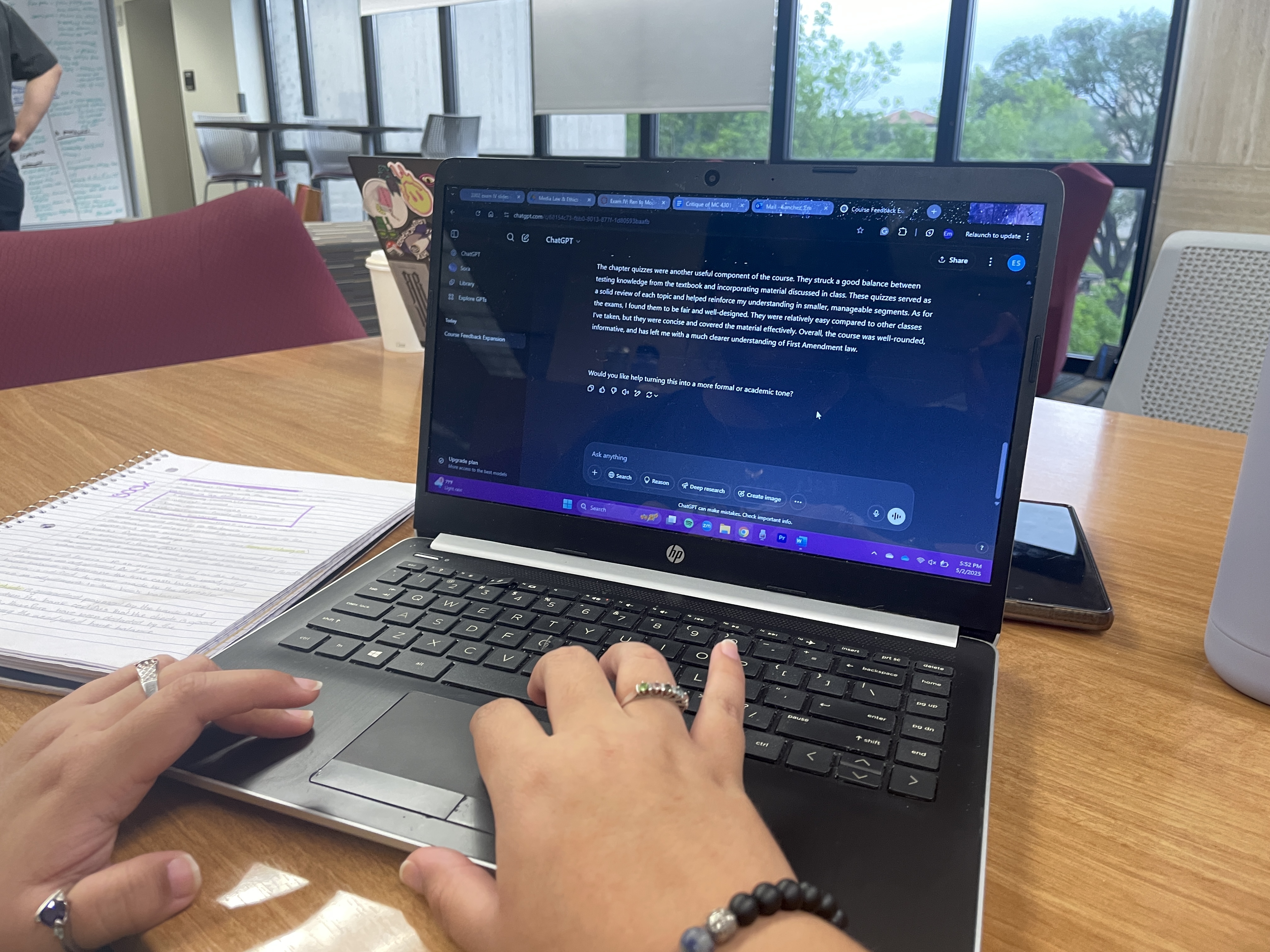
Texas State University student, Em Sanchez, uses ChatGPT to help lengthen a paragraph for an assignment. (Photo credit: Zoe Smith)

College students such as Johann Steinhoff are avid users of ChatGPT. Steinhoff uses the technology as an aid for getting a start on complicated tasks, a personal chatbot when in need of advice, an academic assistant, and more. He believes the use of ChatGPT as a replacement for learning is a personal choice.

“I think it can be used as a scapegoat, but it depends on how you use it. If you don’t want to learn and you’re using ChatGPT for everything, then that’s on you,” he said.

There is a growing public debate about the long-term effects of AI on future jobs and populations. From chatbots helping with homework to fears of causing mass unemployment—AI is reshaping America’s imagination of the future.



The two data sets below display the increased use of AI, a study shown by Statista as well as citizens' thoughts on the use of AI, a study done by the Pew Research Center.

Potential and Concerns

There is a lot of potential when it comes to the use of artificial intelligence in career fields. It can support innovation, ideation, healthcare, and more. However, common concerns about AI include job displacement, misinformation, privacy, and more. At the moment, artificial intelligence is being pushed into many different fields. It has the vast ability to grow and learn much faster than a human mind. For example, while humans might be able to read one article in 5 minutes, some AI technology like Anthropic's Claude AI can digest an entire book's worth of material in under a minute. This amounts to about 100,000 tokens. They are increments of words used to help simplify AI's data processing. This number will only continue to rise.

Not only is its reading ability impressive, but AI is being used to improve so many technological functions. It can sort, analyze, and create data for many different purposes. For this reason, there is a large fear when it comes to the replacement of certain jobs. Have you noticed the chatbots available on websites nowadays? Have you noticed Google’s AI Overview pops up first when you enter your search? AI can be found almost anywhere online in 2025.

Although it is feared as a replacement, artificial intelligence can be used as an amazing tool when prompted correctly. Yvonne Allen, the owner of Enlight Holistics, an e-commerce and retail website guiding the journey of holistic health and wellness, uses AI as a tool in many areas of her work.

“Depending on the project, I use most AI tools interchangeably as both tools and replacements. For example, if I write a blog post, I may use ChatGPT to get topic ideas and rewrite the content based on those ideas. In that way, I am using it as a tool. I see a tool such as Midjourney for AI graphic creation as a replacement. In the past, I used complex and time-consuming Adobe Suite programs for hand drawing and photoshopping graphic design." Allen said.

Allen’s example highlights how AI can speed up tasks rather than eliminate them—at least in some cases. As Allen mentioned, it can also be used to completely substitute tasks such as photography, videography, and the arts when used in online environments. We have not yet reached the point where robots are wedding videographers or concert photographers. A lot of jobs hold a human element that cannot be replaced with today’s technology. While we may not yet see robots filming weddings or photographing concerts, the reality is that AI is increasingly capable of performing tasks once reserved for human professionals.

Nonetheless, with the rise of AI there has been a new sector of job opportunities meant to build and improve AI. Some of these jobs include AI prompt engineers, behavior analysts, model trainers and more. New job opportunities might console some minds, but the jobs being replaced are vastly different from those being made. In order to obtain a career within the field of artificial intelligence, one must have a vast understanding of the inner workings of AI. For this reason, no matter the ill feelings about AI, it is important for younger generations to learn how to use this technology as a tool so that they might be able to implement it into a future career.

College courses within the tech field have already been introducing the topic of AI to students. New software, careers, and AI abilities are being discussed in classrooms around the United States.

Steinhoff said, "Based off of my computer ethics class, automation increases the amount of jobs. There will be more creative options. It could also be useful in certain jobs like a help desk, because AI can work after hours."


...

AI generated photo of an creatively conceptualized AI Engineer made with Midjourney. This photo displays the abilities of generative AI to create fictional photos useful for online content when the resources or time for professional photography are not available. (Image prompting credit: Zoe Smith)


Below is a data set presented by the Pew Research Center displaying thoughts on AI and job replacement differing between citizens and experts.


The Solution

So, what can be done to calm fears and rein in the ever-expanding capabilities of artificial intelligence?

To quell these anxieties, the United States must invest in proactive strategies. Expanding access to AI and tech education, especially in underserved communities, could empower workers to transition into emerging fields. At the same time, reskilling and upskilling programs—supported by both government and private sector initiatives—can help ensure the workforce adapts rather than becomes obsolete.

But adaptation alone isn’t enough. The nation must also focus on setting clear ethical and regulatory guardrails around AI development. This means creating transparent standards for AI use in critical sectors like healthcare, hiring, and law enforcement, while ensuring that the systems themselves remain understandable and accountable.

AI isn’t just shaping the future—it’s redefining the present. The question is no longer whether it will change our lives, but how we choose to manage that change. With thoughtful policy, inclusive education, and ongoing dialogue between experts and citizens, the U.S. can steer AI in a direction that benefits everyone, not just a few.

Email


zoersmith03@gmail.com

Instagram